
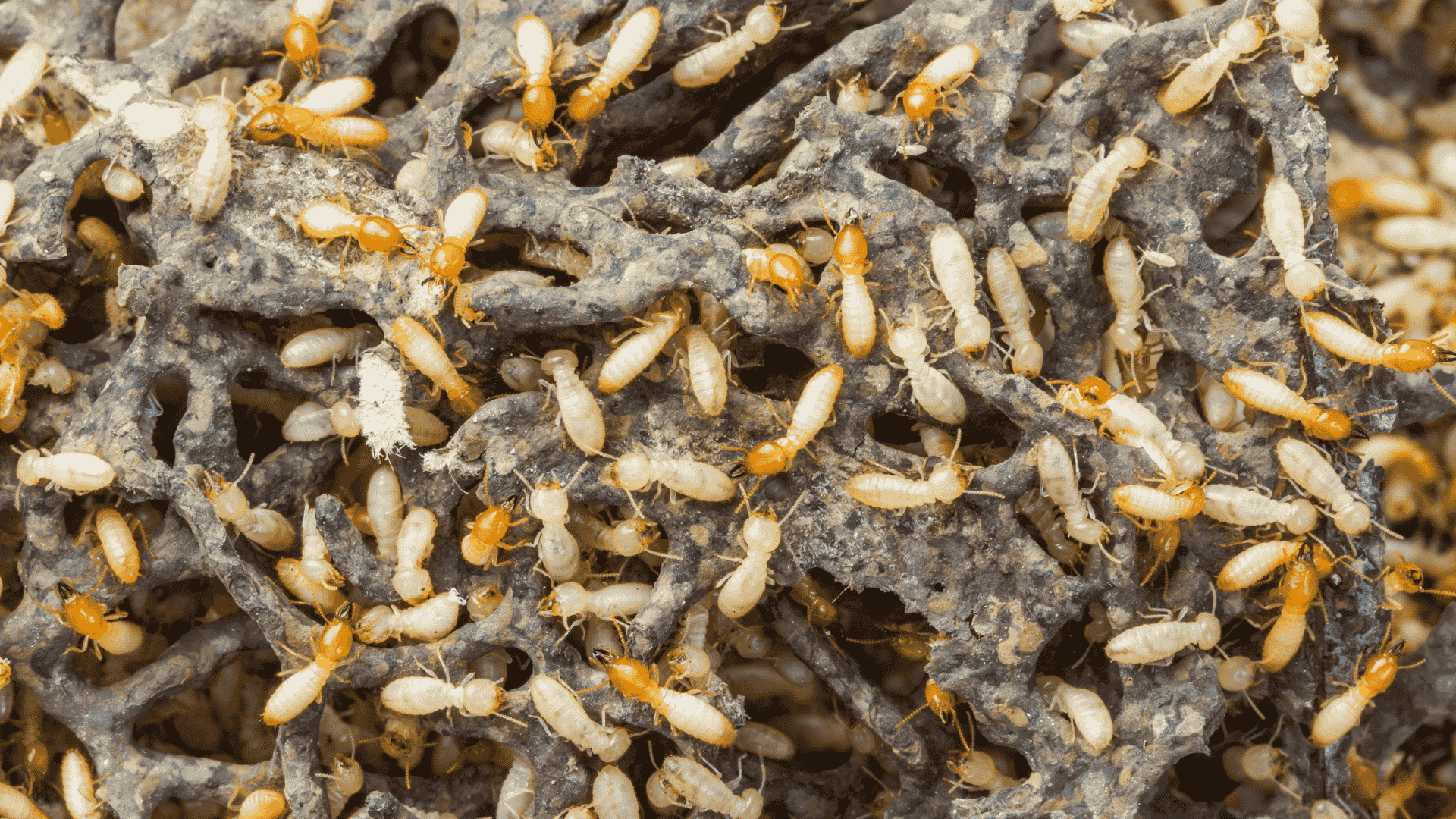
Termites work quietly, and that’s what makes them expensive. A colony can feed on structural wood for months before a homeowner notices anything, and by the time damage is visible, repair costs often dwarf the price of the inspection that would have caught it early.
120 Pest is a family-owned company with more than 30 years of experience treating termites and wood-destroying organisms across north Georgia. We hold a Georgia WDO license, carry ACE certification, and belong to the Certified Pest Control Operators of Georgia. When you schedule a termite inspection in Cumming, GA with our team, you get a licensed inspector who knows local construction styles, soil conditions, and what termite activity looks like here.
Why Forsyth County Homes Face Steady Termite Pressure
Georgia sits in one of the heaviest termite pressure regions in the country, and eastern subterranean termites are active here nearly year-round. Neighborhoods keep expanding into what used to be woodland, so new foundations are frequently poured near established colonies already feeding on stumps, roots, and buried construction debris.
Several factors keep activity consistent across this county:
- Clay-heavy soil that holds moisture against foundations after heavy rain
- Mild winters that allow foraging to continue through much of the year
- Wooded and recently cleared lots with abundant cellulose in the soil
- Irrigation systems and mulch beds installed directly against siding and brick veneer
- Crawl spaces with limited ventilation or drainage issues
- Spring swarms that let mature colonies spread to neighboring properties
None of these guarantee an infestation, but together they explain why termite control is treated as routine maintenance rather than an emergency measure.
What Happens During a Termite Inspection
A thorough inspection is a systematic walk through every area where termites travel, feed, or find moisture. Our inspectors follow a consistent process:
- Exterior perimeter review. We check the foundation, siding, brick veneer, expansion joints, porches, steps, and any wood in contact with soil.
- Landscaping and drainage assessment. Mulch depth, grading, downspout placement, and stored firewood all affect risk and get documented.
- Crawl space or basement inspection. Sill plates, floor joists, subfloor, piers, and support posts are checked for tubing, damage, and moisture.
- Interior evaluation. Baseboards, window and door frames, bathrooms, kitchens, and plumbing penetrations get attention.
- Garage and attached structure check. Garages, decks, and additions often connect a colony to the main structure.
- Findings and recommendations. You get a clear explanation of what was found and what your options are. Estimates for recommended work are free.
Warning Signs Worth a Phone Call
Between scheduled inspections, a few signs deserve immediate attention:
- Pencil-width mud tubes on foundation walls, piers, or joists
- Discarded wings on windowsills, in spider webs, or near light fixtures
- Swarming insects indoors, most commonly in spring
- Wood that sounds hollow or feels soft when tapped
- Bubbling or rippled paint on trim and baseboards
- Doors and windows that suddenly stick or bind
Termite Treatment Options for Local Homes
Foundation type, landscaping, existing damage, and your long-term plans all factor into the recommendation. 120 Pest offers two proven approaches, and both carry a 1-year renewable warranty.
Liquid Termite Treatments
120 Pest is a certified authorized applicator of Termidor products, and liquid termite treatment is the most common recommendation for homes with active infestations. Termidor uses the transfer effect: termites pick up the product as they cross the treated zone and carry it back through the colony, which results in full colony elimination rather than simple repellency. Applied correctly it is undetectable, so termites do not avoid the treated soil the way they avoid older repellent products.
Reasons homeowners choose liquid treatment:
- Eliminates termites currently attacking the structure
- Tested to last 7 to 10 years under normal conditions
- Lower cost to maintain over time than a baiting system
- Uses roughly half the product volume of older-generation chemistries
- Safe for children and pets once the application has dried
Termite Baiting Systems
Termite baiting works differently. Tamper-resistant stations are installed roughly every 15 feet around the foundation, each requiring only a small hole. We use Trelona bait stations, which contain active bait from the day of installation. Their predecessor, the Advance Termite Bait System, required quarterly checks and held no active bait until activity was detected. Trelona removes that waiting period and works around the clock, making it a strong alternative to the Sentricon Termite Always Active system.
Baiting is often the better fit when:
- Established landscaping needs to stay undisturbed
- Pesticide volume is a priority, since active ingredients are measured in grams rather than gallons
- A real estate transaction is on a tight timeline, since stations install quickly
- Protection needs to transfer, since the warranty passes to the new owner
- Child and pet safety is a concern, since the stations lock closed
Deciding Between the Two
We walk through the comparison during your free estimate. Three questions usually settle it:
- Is there active feeding in the structure now, or is this preventive protection?
- How much mature landscaping surrounds the foundation, and how much disturbance is acceptable?
- How long do you plan to stay in the home, and does a transferable warranty matter?
New Construction and Established Homes
Many newer subdivisions in the area received an initial soil treatment during construction. That protection is not permanent, and coverage may have lapsed without the current owner realizing it. If your home is less than ten years old, confirm what was applied, when, and whether the warranty is still active.
Older homes carry a different profile. Settling, added decks and sunrooms, regraded yards, and aging vapor barriers create entry points that did not exist originally. Termite protection works best when the plan matches the actual condition of the structure, which is why the inspection always comes first.
WDO Inspections and Clearance Letters for Real Estate
Termite letters in Georgia are known as the Official Georgia Wood Infestation Report, sometimes called a clearance letter. Nationally, agents request inspections using NPMA form 33, but Georgia requires its own state form instead. The report tells a buyer what the inspector found at the time of inspection, including whether the home is under warranty with a termite company.
Here is how we handle a WDO inspection in Cumming for agents and closing coordinators:
- Contact our office with the property address and closing date.
- We schedule promptly. 120 Pest carries Supra keys and can use a CBS code, which keeps access simple and the visit quick.
- Our licensed inspector completes the report on the required Georgia form.
- If a termite problem is found, we provide a free estimate to remedy the issue.
- Once the work is complete, we reissue the letter free of charge.
Our goal is to keep the termite letter off your critical path. Details are on our WDO and WDI letter page.
Annual Inspections and Renewable Coverage
An annual termite inspection is the least expensive protection available to a homeowner. Both treatment options carry a 1-year renewable warranty, and the yearly visit keeps that coverage current while giving us a chance to catch changes early.
What the annual visit accomplishes:
- Verifies that the treated zone or bait station network remains intact
- Documents new moisture issues, grading changes, or added landscaping
- Confirms that additions and outbuildings are still covered
- Keeps warranty documentation current for a future sale
Landscaping projects, foundation repairs, and new irrigation lines can all disturb a treated zone, so let us know when work like that happens.
Why Homeowners Here Work With 120 Pest
We are a family-owned company, not a franchise run from a call center in another state:
- More than 30 years of hands-on termite and pest experience
- Georgia licensing for pest control and wood-destroying organisms
- ACE certification and CPCO of Georgia membership
- Certified authorized applicator of Termidor products
- Trelona baiting installation with transferable, renewable warranties
- Supra key access for real estate inspections
- Free estimates on all recommended termite work
Many customers who start with a termite inspection also add residential pest control and keep everything with one company.
Frequently Asked Questions
How often should I schedule a termite inspection?
Once a year is the standard recommendation for Georgia homes. Properties with a history of activity, chronic moisture problems, or heavy wood-to-soil contact may benefit from more frequent monitoring.
How long does an inspection take?
Most single-family inspections take under an hour. Homes with large crawl spaces, multiple additions, or difficult access take longer, and we give you a realistic window up front.
What does a termite inspection cost?
Pricing depends on the size and construction of the home and whether the inspection is for a real estate transaction or ongoing protection. Contact our office for a quote. Estimates for recommended treatment work are always free.
Will my homeowners insurance cover termite damage?
Standard policies generally exclude termite damage because it is considered preventable through maintenance. That is the main reason inspections and active warranty coverage matter.
Can you provide a clearance letter on a short timeline?
In most cases, yes. Because we carry Supra keys and can work with a CBS code, access and inspection usually happen without waiting on a separate showing appointment.
Is a baiting system as effective as a liquid treatment?
Both are effective when properly installed and maintained. They work through different mechanisms, and the right choice depends on your property’s construction, landscaping, and current activity.
Schedule Your Inspection
Termite damage is cumulative, and waiting rarely improves the outcome. Whether you need an annual inspection, a clearance letter for a closing, or a treatment plan for confirmed activity, our licensed inspectors serve homeowners and agents throughout Forsyth County.
Call 120 Pest at (404) 247-8091 or reach out through our contact page to schedule, or review our full termite control and inspection services first. Office hours are Monday through Friday, 8:00 AM to 5:00 PM, and Saturday from 9:00 AM to 12:00 PM, with additional appointments by request.