
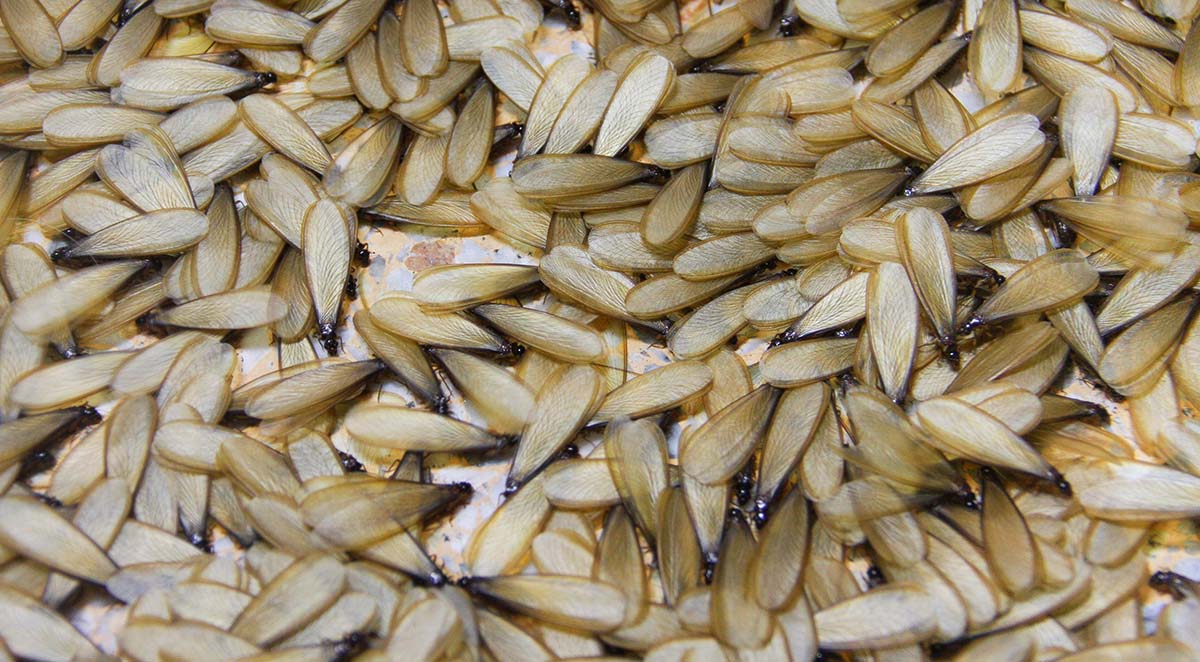
Few things stop a Georgia homeowner in their tracks quite like walking into a room and finding hundreds of winged insects crawling across a windowsill. If you’ve experienced this, you’re likely dealing with termite swarmers. Their presence is one of the clearest warning signs that a colony is active near your home.
Georgia sits squarely in what entomologists call the “termite belt,” a region of the southeastern United States where warm temperatures, high humidity, and frequent rainfall create ideal conditions for subterranean termites to thrive year-round.
What Are Termite Swarmers?
Termite swarmers, also known as alates, are the reproductive members of a termite colony. When a colony matures it produces winged males and females whose sole purpose is to leave the nest, mate, and establish new colonies. These swarmers emerge in large groups, often numbering in the hundreds, and fly toward light sources such as windows, doors, and outdoor fixtures.
Swarmers themselves do not cause structural damage. They don’t eat wood, and most die within hours if they can’t find suitable soil. However, their presence confirms that a mature, established termite colony exists nearby. After a brief flight, swarmers shed their wings, pair off, and burrow into the soil to begin reproducing. Those discarded wings near windowsills and doorways are one of the most common signs homeowners notice after an indoor swarm.
When Termites Swarm in North Georgia
Termite swarming season in Georgia typically runs from late February through May. The primary triggers are rising soil temperatures, particularly once they reach 70 degrees Fahrenheit, combined with high humidity, often following a warm spring rain. Homeowners are most likely to encounter swarms under these conditions:
- A warm, sunny day following a period of rain
- Daytime hours, typically between late morning and early afternoon
- Spring months from March through May, though February swarms are possible during unusually warm years
Eastern subterranean termites, the most common species in Georgia, swarm during daylight. Less common species like Formosan termites may swarm at night near outdoor lighting. Regardless of species, any swarming activity near or inside your home warrants immediate attention.
It’s also important to understand that while swarming peaks in spring, termites remain active year-round in this region. Georgia’s soil rarely freezes deep enough to force colonies into dormancy, and colonies that have found warm, moist conditions beneath a home can feed continuously through every season.
Read more in our blog about the common signs of termite infestation.
Termite Swarmers vs. Flying Ants: How to Tell the Difference
Confusing termite swarmers with flying ants is one of the most common identification mistakes homeowners make. Both emerge in swarms during warm weather, but there are reliable ways to distinguish them:
- Body shape — Termites have a straight, oval body with no visible waist. Flying ants have a distinctly pinched waist between the thorax and abdomen.
- Wings — Termites have two pairs of equal-length wings extending well past the body. Flying ants have a longer front pair and a shorter rear pair.
- Antennae — Termite antennae are straight or slightly curved. Ant antennae are bent at a sharp angle.
- Color — Termite swarmers are typically dark brown to black with a uniform appearance.
If you’re unsure, collect a few specimens in a sealed bag or take a clear photo. A pest control professional can confirm identification quickly.
Why a Swarm Means You Likely Have a Problem
A termite swarm inside your home is not a random event. Colonies don’t produce swarmers until they’ve been growing for several years. If swarmers are emerging from cracks in your floor, around window frames, or through foundation gaps, it almost certainly means an established colony has been feeding on your property for a significant period.
Even an outdoor swarm near your foundation is cause for concern. Swarmers don’t travel far, so a swarm on your porch or along your home’s perimeter suggests an active colony within close proximity to the structure. The challenge with subterranean termites is that worker termites travel through underground mud tunnels between the soil and the wood they consume, meaning damage can accumulate for years before anything visible appears.
Read about the difference between a termite bond and warranty.
What to Do If You See Swarmers
If you discover termite swarmers in or around your home, follow these steps:
- Don’t panic, but don’t ignore it. The swarmers aren’t damaging your home, but the colony that produced them may be.
- Collect a sample in a sealed bag or jar, or take a close-up photo for professional identification.
- Note the location. Were they near a window? Emerging from a baseboard? On the porch? This helps a technician pinpoint where the colony may be accessing the structure.
- Do not attempt DIY treatment. Over-the-counter sprays kill visible swarmers but do nothing to the colony underground. Surface sprays can actually scatter termites and complicate professional treatment.
- Schedule a professional termite inspection as soon as possible.
Other Signs of Termite Activity
Between swarm seasons, stay alert for these indicators of an active infestation:
- Mud tubes on foundation walls, piers, or crawl space surfaces — pencil-width tunnels built by workers traveling between soil and wood
- Discarded wings near windows, doors, or light sources
- Hollow-sounding wood when tapping baseboards, door frames, or beams
- Buckling or warped floors suggesting subflooring damage
- Maze-like patterns visible in damaged wood
- Doors or windows that suddenly become difficult to open or close
If you notice any of these signs, don’t wait for swarming season. Termites feed continuously, and delay only increases repair costs.
Treatment Options: Liquid vs. Baiting
When an inspection confirms an active infestation, two primary treatment methods are available.
Liquid termite treatments apply a termiticide around your home’s foundation perimeter. Products like Termidor use transfer effect technology, which means that termites crossing the treated zone pick up the product and carry it back to the colony, ultimately eliminating the entire group. The product is undetectable to termites, preventing avoidance. Modern formulations are tested to last seven to ten years under normal conditions and use roughly half the volume of older products.
Termite baiting systems like Trelona stations take a different approach. Tamper-resistant stations installed approximately every 15 feet around the foundation contain active bait from day one. Baiting uses a far smaller amount of product (measured in grams rather than gallons), leaves a minimal footprint in landscaping, and transfers easily to new homeowners during real estate transactions.
Both methods include a one-year renewable warranty. The best choice depends on your property’s construction, conditions, and long-term protection goals. A termite inspection will help determine which option fits your situation.
Prevention Tips for Georgia Homeowners
Professional treatment handles active infestations, but every homeowner can take steps to reduce the risk:
- Fix leaky faucets, repair gutters, and direct downspouts away from the foundation to eliminate moisture
- Keep firewood, lumber, and mulch away from the home’s exterior
- Remove dead trees, stumps, and wood debris from the yard
- Seal cracks and gaps in the foundation and around utility penetrations
- Ensure crawl spaces are properly ventilated
- Schedule annual professional inspections to catch activity before it becomes a full infestation
The Cost of Ignoring Termite Swarms
Termites cause an estimated $5 billion in property damage across the United States each year, affecting roughly 600,000 homes. The average homeowner who discovers damage spends approximately $3,000 on repairs, and severe structural cases can cost far more. Most critically, homeowner’s insurance typically does not cover termite damage — insurers consider it a preventable maintenance issue.
A swarm dismissed as “just bugs” in March can become a serious repair bill by the time the damage surfaces during a renovation or home sale. The cost of an annual inspection and preventive treatment is a fraction of what even minor structural repairs would run. If you need a WDO report for a real estate transaction, that inspection doubles as your first line of defense.
Frequently Asked Questions About Termite Swarms
When do termites swarm in Georgia?
Termite swarming season in Georgia typically runs from late February through May, peaking in March and April. Swarms are triggered by warming soil temperatures and humidity, usually appearing on warm days following rain.
Can termite swarmers damage my home?
Swarmers do not eat wood or cause structural damage. Their purpose is reproduction. However, their presence inside your home strongly indicates a mature colony is actively feeding nearby.
What should I do if I find discarded wings but no live insects?
Discarded wings confirm a recent swarm. Schedule a professional inspection even if you didn’t witness the swarm — the colony that produced those swarmers may be feeding on your property.
How can I tell if it’s termites or flying ants?
Look at the body and wings. Termites have straight, broad bodies with no waist and equal-length wings. Flying ants have a pinched waist and wings of unequal length. Termite antennae are straight; ant antennae are sharply bent.
Is one termite inspection enough?
Annual inspections are strongly recommended in Georgia. Subterranean termites are active year-round here, and colonies can establish themselves and cause significant damage between inspections. An annual check is the most reliable way to catch new activity early.
Contact 120 Pest for Termite Inspection
Termite swarms are nature’s way of telling you something is happening underground. If you’ve seen flying termites around your property or discovered discarded wings inside your home, don’t wait to find out how far the damage has gone. Contact 120 Pest to schedule a thorough termite inspection. With over 30 years of experience and ACE certification, our team knows exactly what to look for, and how to protect your home from one of Georgia’s most destructive pests.